.png)
Home renovations
Brisbane's townhouse market presents developers with more than one path to a successful project.
You can retain completed dwellings and build a long term rental asset, or develop, sell and recycle your capital into the next opportunity.
Understanding the difference between these strategies can help you make a more informed development decision.
Build to rent, commonly referred to as BTR, involves developing residential properties specifically for long term rental ownership.
Rather than selling each townhouse after construction, the completed development remains under common ownership and generates rental income over time.
For investors, build to rent townhouses Brisbane can provide an alternative to traditional development strategies where the primary return comes from property sales.
The model places greater emphasis on the completed asset.
Location, floor plan functionality, construction quality, tenant appeal, operating costs and rental demand can all influence long term performance.
Queensland's planning framework provides a specific definition for qualifying build to rent housing. The current framework requires a BTR development to contain at least 50 dwellings, with requirements including residential tenancy arrangements, centralised ownership, no individual titles and onsite management.
This requirement is important for Brisbane townhouse developers.
A smaller development containing several townhouses intended for rental may operate as a conventional residential development and rental investment rather than qualifying under the specific BTR land use definition.
For larger projects, the BTR framework provides a clearer planning pathway for a purpose built rental model.
The build to sell townhouse Brisbane model follows a more familiar development pathway.
The developer acquires the site, obtains the required approvals, constructs the townhouses and sells the completed dwellings to individual buyers.
Revenue is generated through property sales rather than ongoing rental income.
This model can appeal to developers who prefer a defined project cycle.
Once construction is complete and settlements occur, capital can be released for another investment or development opportunity.
The model also allows developers to respond directly to buyer demand within the chosen Brisbane suburb.
Design decisions can be shaped around the intended purchaser, whether that means creating spacious family townhouses, low-maintenance homes for professionals or premium residences suited to downsizers.
The key consideration is the relationship between development cost and achievable sale value.
Land acquisition, construction, professional fees, finance, holding costs, marketing and selling expenses all need to be included when assessing the potential project margin.
The financial difference between the two models largely comes down to when the project generates its return and whether the completed property remains under ownership.
A build to sell strategy focuses on capital realisation through sales.
A build to rent strategy focuses on recurring rental income alongside the potential long term growth of the retained asset.
Neither strategy should be selected from projected revenue alone.
A developer should compare the total capital required, finance costs, construction period, holding costs and expected return under each scenario.
For build-to-rent, the feasibility should include realistic rental assumptions, vacancy allowances, management expenses, maintenance and longer-term ownership costs.
For build to sell, the assessment should include realistic selling prices, sales costs, marketing expenses, settlement timing and potential changes in market conditions.
This creates a clearer comparison between the two strategies.
The BTR vs selling townhouse Brisbane decision also requires a close look at risk.
Build to rent places greater emphasis on ongoing asset management.
Tenant demand, vacancy, maintenance, rental management and operating expenses can influence the property's performance after completion. The quality and durability of the development therefore remain important long after construction finishes.
Build to sell places greater emphasis on the sales market.
Buyer demand, comparable townhouse values, interest rates, competition and the timing of settlements can influence the final project outcome.
A strong development location can support either model, although each strategy responds to different market conditions.
A build to rent project needs sustained rental demand capable of supporting occupancy and rental income.
A build to sell project needs sufficient buyer demand and a product that aligns with what purchasers are seeking within the local market.
This is why market research should form part of the feasibility process before the development is designed.
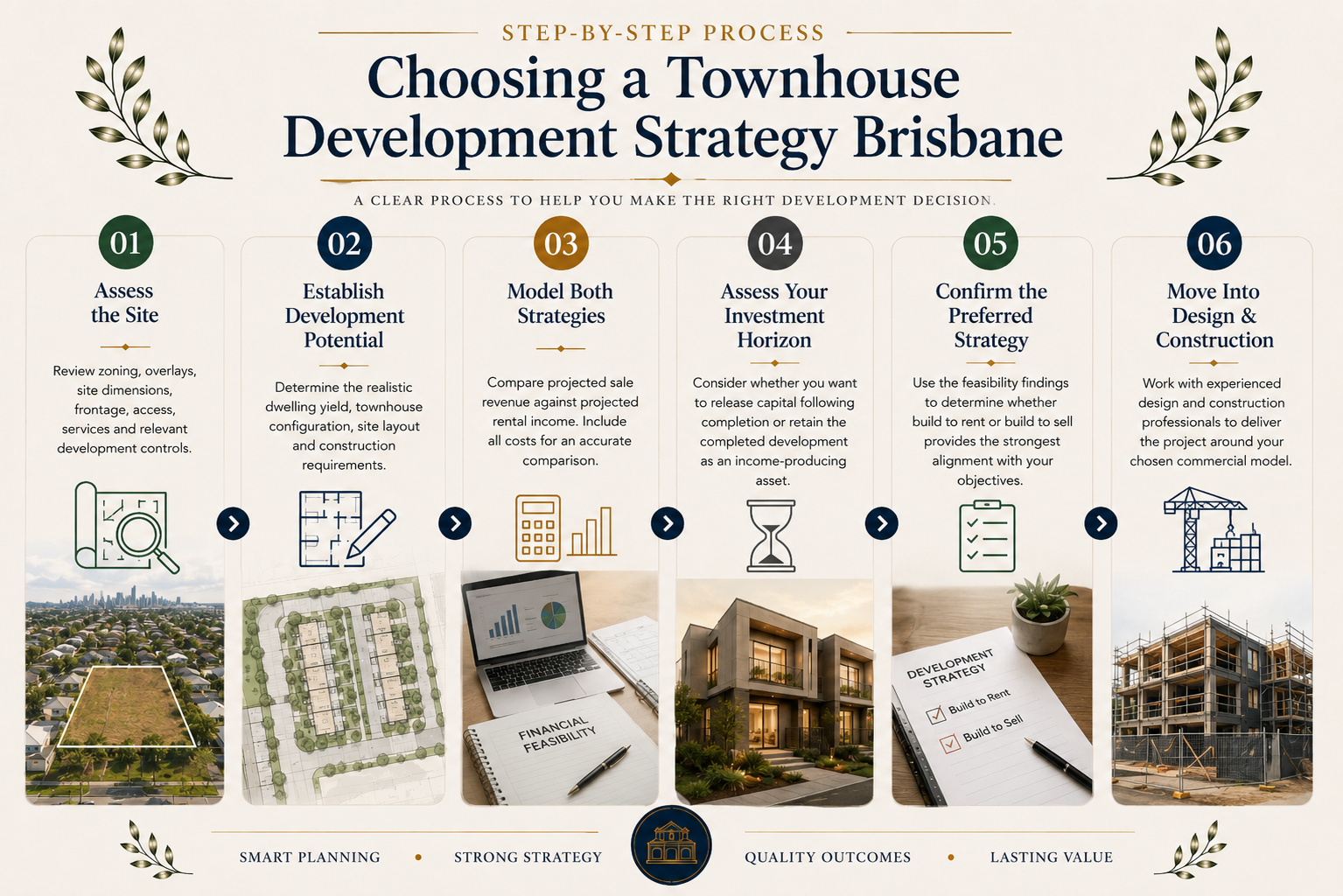
Review zoning, overlays, site dimensions, frontage, access, services and relevant development controls.
Determine the realistic dwelling yield, townhouse configuration, site layout and construction requirements.
Compare projected sale revenue against projected rental income. Include construction costs, professional fees, finance, holding costs, management expenses and selling costs.
Consider whether you want to release capital following completion or retain the completed development as an income-producing asset.
Use the feasibility findings to determine whether build to rent or build to sell provides the strongest alignment between the site, funding structure and long term objectives.
Once the strategy has been established, work with experienced design and construction professionals to develop the project around the selected commercial model.
A build to sell townhouse Brisbane project may suit developers who prefer a defined exit and want to recycle capital into another project.
The strategy can work particularly well where the site supports strong buyer demand and the projected sales values provide an attractive margin after development costs.
Build to rent townhouses Brisbane can suit investors with a longer investment horizon who want to retain ownership and generate ongoing rental income.
The model can also provide greater control over the completed residential asset, with future decisions centred around rental performance, management and long term asset value.
For larger developments, Queensland's current BTR planning definition should be assessed early because qualifying projects need to satisfy specific requirements.
Ultimately, the right approach depends on the individual site and your objectives.
A strong townhouse development strategy Brisbane should connect the site's planning potential with the financial model, construction requirements and preferred exit or ownership structure.
Choosing between build to rent and build to sell comes down to how you want your Brisbane development to perform. Build to rent can support long term rental income and asset ownership, while build to sell can provide a defined exit and capital for your next project.
Abode Construction combines thoughtful design with quality construction to help bring residential projects to life. From home design and renovations to extensions, custom builds and townhouse development, our team guides each project from concept through to completion.
Abode has built and renovated hundreds of upmarket homes across Brisbane, with an emphasis on considered design, quality construction and lasting appeal.
Ready to explore your development options? Book a consultation with Abode Construction and discuss the right path for your project.
Build to rent townhouses Brisbane are retained as rental assets, while a build to sell townhouse project in Brisbane generates returns through property sales.
Planning requirements depend on the site's zoning, overlays and proposed development. A project-specific assessment should be completed before progressing.
Queensland's specific BTR definition applies to qualifying developments with at least 50 dwellings and other requirements. Smaller projects may follow conventional residential planning pathways.
Build to sell townhouse Brisbane projects can suit developers seeking capital recycling, while build to rent townhouses Brisbane can suit investors focused on long term income and ownership. The right townhouse development strategy Brisbane depends on the site, finances and investment goals.